
The Journal of the American Chemistry Society

2026-04-15T20:54:21+00:00

The Journal of the American Chemistry Society The ultrafast formation of Jahn-Teller polarons is unraveled in spinel Co3O4 with microscopic detail. Selective charge-transfer excitation leads to a local symmetry breaking caused by the Jahn-Teller effect, which is associated with charge localization on the 3orbital at the Cobalt octahedral site, influencing deformation potential and magnetoelastic coupling of the system. This study offers an effective route towards local engineering of transition metal oxides' electronic and structural properties with ultrafast light pulses. Find out more


The Journal of the American Chemistry Society2026-04-15T20:54:21+00:00

2026-04-15T20:53:54+00:00

OPTICA Vol. 11, Issue 3, pp. 403-411 Twisted-phase OAM illumination and its resulting diffraction pattern in single-shot ptychography experiments at an FEL source. Find out more

2026-04-15T20:53:54+00:00

The Journal of Physical Chemistry Letters

2026-04-15T20:43:51+00:00

The Journal of Physical Chemistry Letters Volume 13, Issue 14, pages 3310-3528 We provide a comprehensive atomic-scale description of the purely thermal response of lead-halide perovskites in a temperature range relevant for realistic applications. Thermal-induced changes are rationalized in terms of displacive phase transitions, which are a consequence of the phonon anharmonicity of the inorganic lattice. Find out more

The Journal of Physical Chemistry Letters2026-04-15T20:43:51+00:00

The Journal of the American Chemical Society

2026-04-15T20:53:04+00:00

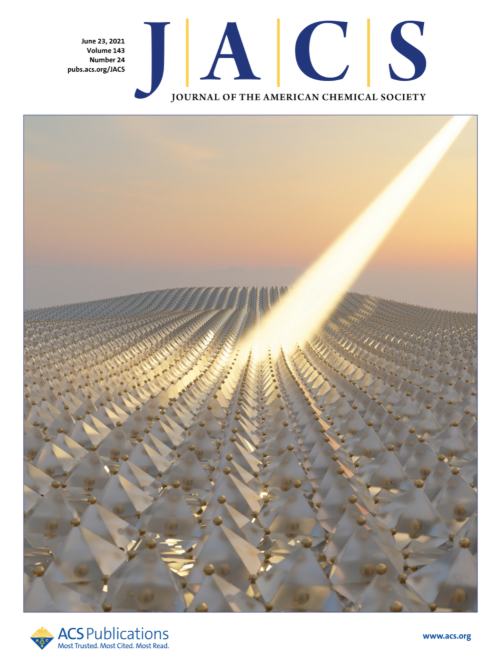
The Journal of the American Chemical Society Volume 143, Issue 24, pages 8949-9276 Light activation of lead-halide perovskites induces polaronic lattice distortions, here quantified with atomic-level precision. Electron-phonon coupling drives the crystal changes, which are unlocked upon charge-carrier recombination and in the absence of thermal effects. This study clarifies the structure-property relationships in out-of-equilibrium conditions, underpinning the developments of perovskite-based devices.  Find out more

The Journal of the American Chemical Society2026-04-15T20:53:04+00:00

Structural Dynamics

2026-04-15T20:44:11+00:00

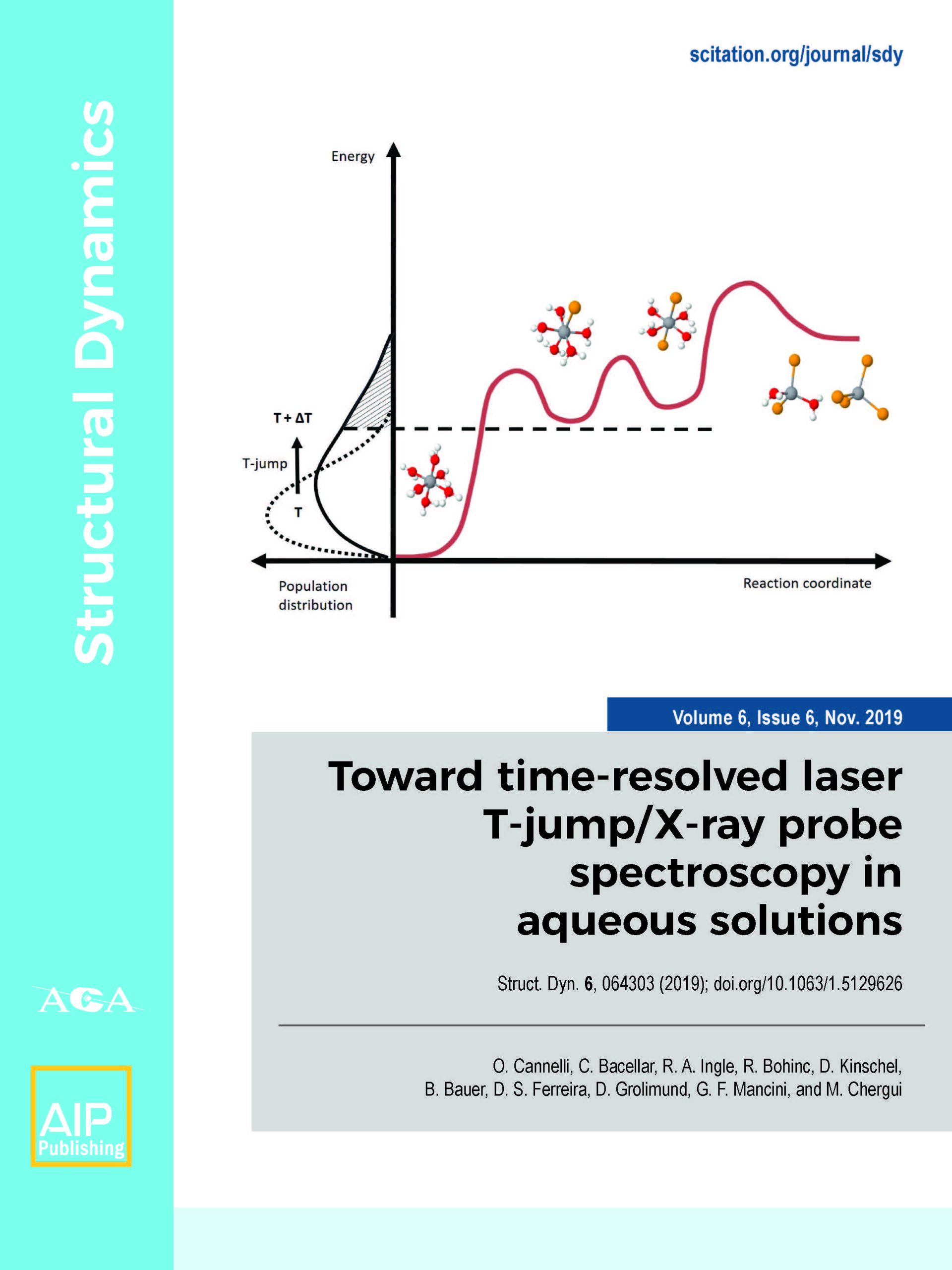
Structural Dynamics Volume 6, Issue 6, 064303 Most chemical and biochemical reactions in nature and in industrial processes are driven by thermal effects that bring the reactants above the energy barrier for reaction. In aqueous solutions, this process can also be triggered by the laser driven temperature jump (T-jump) method, in which the water vibrational (stretch, bend, or combination) modes are excited by a short laser pulse, leading to a temperature increase in the irradiated volume within a few picoseconds.  Find out more

Structural Dynamics2026-04-15T20:44:11+00:00
Go to Top